England women play 500th game: Landmark Lionesses moments
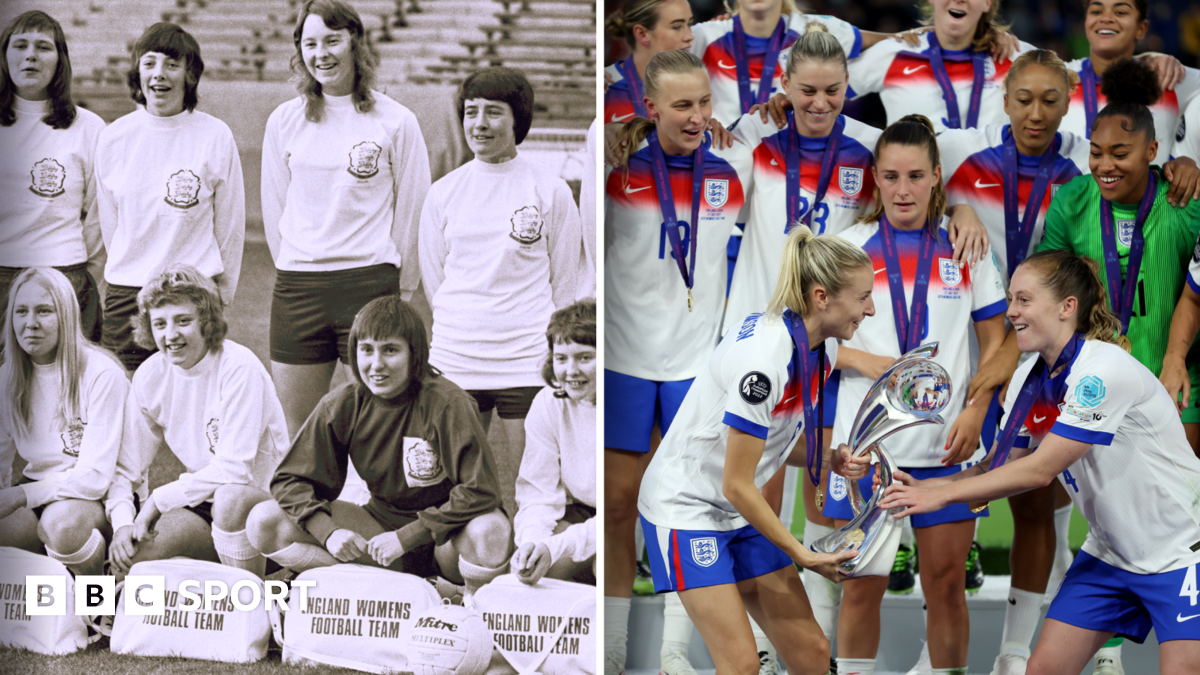
England's Lionesses are no strangers to making history.The past decade has been rich in landmark moments; a first tournament medal, a first major trophy, and a first title defence - on foreign soil to boot.When Sarina Wiegman's side play Iceland in Reykjavik on Saturday (17:30 BST) they will reach another milestone - the 500th fixture for England's senior women's team.The game is important for securing qualification for next year's World Cup in Brazil, with England keen to win more silverware in the famous white shirt.But regardless of the result, the match will be etched in history as a reminder of how far the English women's game has come.In 1921, the Football Association (FA) banned women's football, considering the game "most unsuitable for females", external.The decision consigned women's football to park pitches and small venues for half a century before the decision was overturned in 1971.To mark 500 not out, BBC Sport takes a look at 11 defining moments in the history of England's women.The moment it all began - officially.Although an unofficial England side had played in front of 90,000 fans in Mexico's Azteca Stadium in a global women's tournament in 1971, this was the first proper Women's Football Association (WFA) England team.It was November 1972 and England travelled north to face Scotland at Ravenscraig Stadium in Greenock.In front of 400 fans, the Lionesses edged a thrilling game, coming from behind to secure a 3-2 victory.A year later, the teams played again for England's first official home match and the Lionesses claimed a resounding 8-0 victory in Nuneaton.England made their major tournament debut in 1984, competing as one of four teams in a Uefa competition that was a precursor to the Women's Euros.After overcoming Denmark 3-1 over two games, they faced a two-legged final against Sweden.The Swedes won the first encounter in Gothenburg thanks to teenager Pia Sundhage's strike, but Linda Curl's goal settled the second in England's favour at Luton Town's Kenilworth Road.The trophy was decided by a penalty shootout, with Sweden prevailing 4-3 after Curl was unable to convert her spot-kick.The year 2005 was pivotal as England hosted a major women's tournament for the first time.The European Championship demonstrated the Lionesses could attract big crowds, with 29,092 fans attending their opening game against Finland at City of Manchester Stadium, and further figures of 14,695 and 25,694 for games against Denmark and Sweden at Blackburn Rovers' Ewood Park.It also illustrated broader interest in the women's game across the country, with the final between Germany and Norway attended by 21,105 spectators.The BBC broadcasted all England's games and the final, with the Sweden fixture peaking at three million viewers.As reigning European champions England headed to Australia as one of the favourites for the 2023 World Cup, albeit without injured captain Leah Williamson and striker Beth Mead, both absent with anterior cruciate ligament (ACL) injuries.After three wins from three in the group stage, they battled past Nigeria, Colombia and hosts Australia to reach the final in Sydney.However, their World Cup adventure ended in heartbreak as they fell to a 1-0 defeat by Spain.After winning their maiden title three years earlier, and reaching a World Cup final in the interim, there was huge pressure on the Lionesses to deliver a strong European Championship defence in Switzerland.It started badly, with a 2-1 defeat by fellow contenders France, but from that point on Wiegman's side accelerated.Emphatic wins over the Netherlands and Wales granted access to the knockout stage, before a nail-biting shootout win against Sweden and a last-gasp victory over Italy secured a final rematch against world champions Spain.It was another tight contest that went the distance, with Kelly's contribution once again proving decisive as she scored the final penalty in a shootout to defend England's status as European champions.




Most Popular