The women behind the scenes who make Para Alpine skiing magic
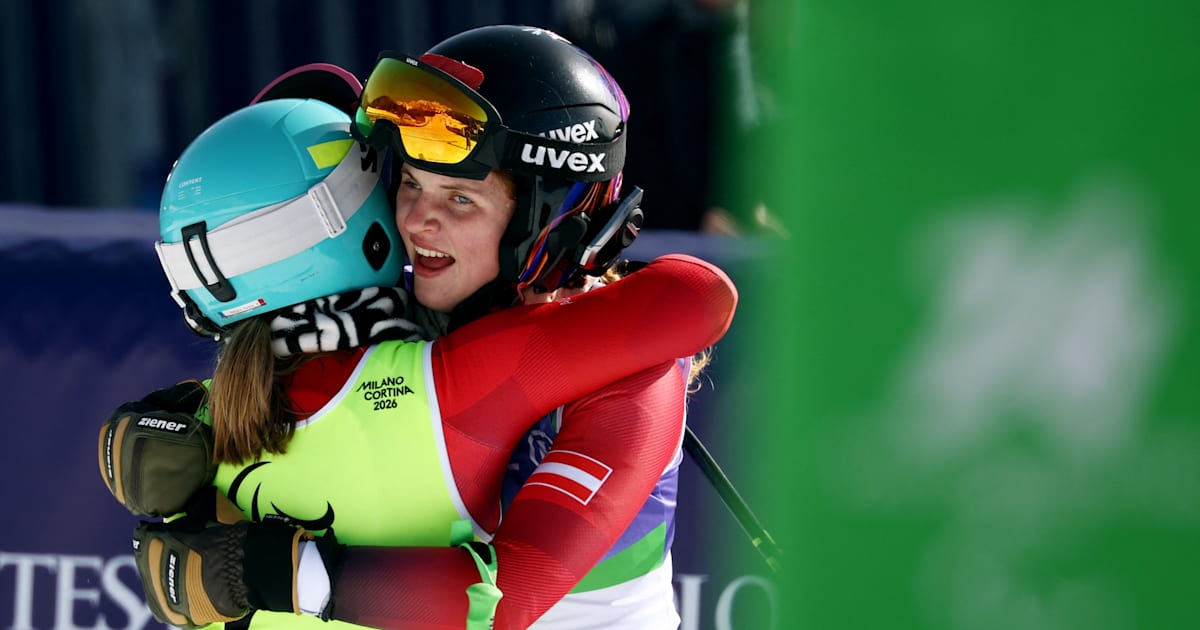
Para alpine skiing may still be a predominantly man’s world, but most of the athletes would not be there if not for the extraordinary women in their lives.From the mothers who let them try a risky sport, accepting the inevitable falls and bruises, to the sisters who get up before dawn to train with them, the female physios who help them return from major injuries, and role models who inspire them, the Para alpine world is full of examples of strong women who are leading female and male Para athletes alike.When Dutch sit skier Niels de Langen won a silver medal in the opening downhill race on Saturday (7 March), his first move was to rush to the stands, jump out of his wheelchair, and scale the metal barrier to hug his wife Nastasia.Austria’s Veronika Aigner won her first Paralympic medal, crossing the finish line with her elder sister and guide Elisabeth.The first person Enrique Plantey looked for at the Tofane Alpine Skiing Centre after finishing his race was his mother: her grey hair, Argentinian football jersey and smiling face.And when Paralympic champion Mollie Jepsen needed to make a comeback for the Milano Cortina 2026 Paralympic Winter Games after three seasons of being sidelined with injuries, it was female coaches and physiotherapists she relied on.“I'm all women-built team in order to be back here on snow, which I think is so cool, because I don't think that would have been a thing 20 years ago, 10 years ago,” Jepsen told Olympics.com. “The only reason I'm here is I'm standing on a bunch of women who just lifted me up, carried me when I was down, and helped me get back here.”Winter Paralympics 2026: Key storylines and athletes to watch at the Milano Cortina 2026 Paralympic GamesThe mother rocks behind elite Para alpine skiersSix-time Paralympic medallist Menna Fitzpatrick does not doubt it: She would never have taken up Para alpine skiing if not for her mother Mair.And it’s not that her mother is an elite skier herself. It’s simply that she let her daughter make any mistakes, however painful, without interfering.“She was really good at actually allowing me to have independence as I was a kid,” the British vision impaired skier said. “It must have been really, really tricky to watch a kid fall and then not go over and help until they picked themselves up.”Argentina's Enrique Plantey jokes that his mother is his “best sponsor”. And there is some truth to this statement.His mother bought Plantey his first sit ski and helped finance his training at quality resorts at the start of his skiing career.“She is not a sport woman, but when I had the possibility to buy my first chair, she said, ‘If you will use it, I'll buy it for you’. She bought me a mono ski,” Plantey said. “She supported me all the time so that I would continue to get better and for my first trips, she was the person who helped me to travel and go to the United States, to the outside world, to start growing in sport.”But more than the financial support that his mother has given him at the start of his career, it is her example of resilience that made the biggest impact on the man Plantey would grow up to be.“I had an accident when I was 11 years old and in this accident, my father and one brother died, and we are five children. We continued as four, and she is a happy and strong woman and continued with all the family and was a really big pillar in our lives,” Plantey recalled. “I knew how to carry my disability in a very natural and beautiful way, and a great part of what I am is thanks to her support, her strength and her joy.”USA’s Spencer Wood has also received a good share of lessons from his mother, Barb throughout his life. It is these lessons that he carries with him in his races at Milano Cortina 2026 as he skis in her memory.“My mother passed away three years ago. And she just always reminded me, ‘Woods don't quit. We don't quit. No matter how hard it gets, we finish, we see it through’. And that's the mentality you bring every single day, especially in ski racing, because when it gets hard, that's when you start to really learn,” Wood said. “I'm so grateful for her and all the messages she passed on to me for so many years. And I love her dearly. I know she's watching over me.”Sister acts and girlfriends in the standsFor Milano Cortina 2026 downhill champion Ebba Årsjö, her mother is a one-woman support crew.“My mom has always been there, cooking all the meals, fixing everything, hugging everyone,” the Swedish Para athlete said with a laugh.But even with her mother’s help, Årsjö might have opted out of Para alpine skiing if not for one person who was willing to share the early wake-up alarms with her.“My sister – we are really close, she's just one year younger than me – she skied her whole life as well,” Årsjö said. “I wouldn't be able to do this without her, because it's been many hard days with just me and her going up early in the slope, and we did it together.”The skiing journey was also a sister act for Katie Guest, Menna Fitzpatrick’s guide in the vision impaired class. She is the younger sister of two-time Olympian Charlie Guest, who competed at PyeongChang 2018 and Beijing 2022.“My mum and my elder sister Charlie are huge in it, and my little sister as well. As a family, we're really close-knit,” Guest said. “They've been a support crutch for ages, so they're incredible.”No training session is spent alone for Giacomo Bertagnolli since he skis with his guide Andrea Ravelli. But sometimes a special guest comes to cheer him on as well, his girlfriend Pamela.“There are so many people that I should thank but I would say thank you to my girlfriend because she's always with me,” Bertagnolli replied when asked about the most influential women in his career. “When she has time and she can, I always bring her with me.”For Arly Valasquez, who was Mexico’s only representative at the last four Paralympic Winter Games, girlfriend Katia’s presence at Milano Cortina 2026 is a welcome reprieve from his usual solitary Games experience.But Katia is in Cortina not only to support her boyfriend. She is also his coach.“We have been together for the last two seasons. We live together in Mexico and then we travel around whatever races we can,” Velasquez said. “We make (sourdough) bread, she became a really nice baker. She's actually a better baker than me. And... it's finally like flying around the world with family!”The women behind the starting gates and podiumsWinning three medals at Beijing 2022 should have been a moment of pure joy for Ebba Årsjö but when she returned to Sweden, she felt her love for the sport start to wane.Skiing was no longer “fun”. A big part of that was due to how lonely she felt on an all-male team. But that has now changed with a female coach and physiotherapist coming onboard.“It was actually tough a couple of years after the Games. There was a lot of time alone in the hotel room," Årsjö said. "Now we've done a lot of changes in the team. We're bigger, we have girls in the team. And the culture has changed. So I'm so much happier going for ski camps. And I enjoy skiing now. It's like I've reached a point where this is what I want to feel when I ski.”The new team members are close to Årsjö in age, which also brings them closer together.“I know one of them from high school!" Årsjö exclaimed. "And it's so nice to just talk about girl things, for a change."Canada’s Mollie Jepsen counts herself lucky to have had a strong female team staff from the start, especially as the six-time Paralympic medallist was making a comeback from three seasons marred by injuries and knee surgeries.“All of them,” Jepsen said of how many women had a role in her return to the slopes. “Laura Strenger, our new S&C (strength and conditioning) is a woman, Kayla Dodson's back at home, she's a female. All my physios. Our physio Jenny Dea is here with us. Maggie Phillips-Scarlett who was at the Olympics with halfpipe, she is my physio at home. They're all women.”Britain’s most decorated Winter Paralympian Menna Fitzpatrick also faced an uphill climb from injury ahead of Milano Cortina 2026 and, like Jepsen, she relied on female professionals, including coach Jo Ryding and physiotherapist Kate Rademaker, to get back on the slopes.“Without them, I don't think we would actually be here,” Guest said. “They've been absolutely instrumental in Menna's return to snow.”



Most Popular

First One-Day International - The Stats Zone
3 hours ago