Indian Wells recap: The strangest match point of the year, missing balls and more

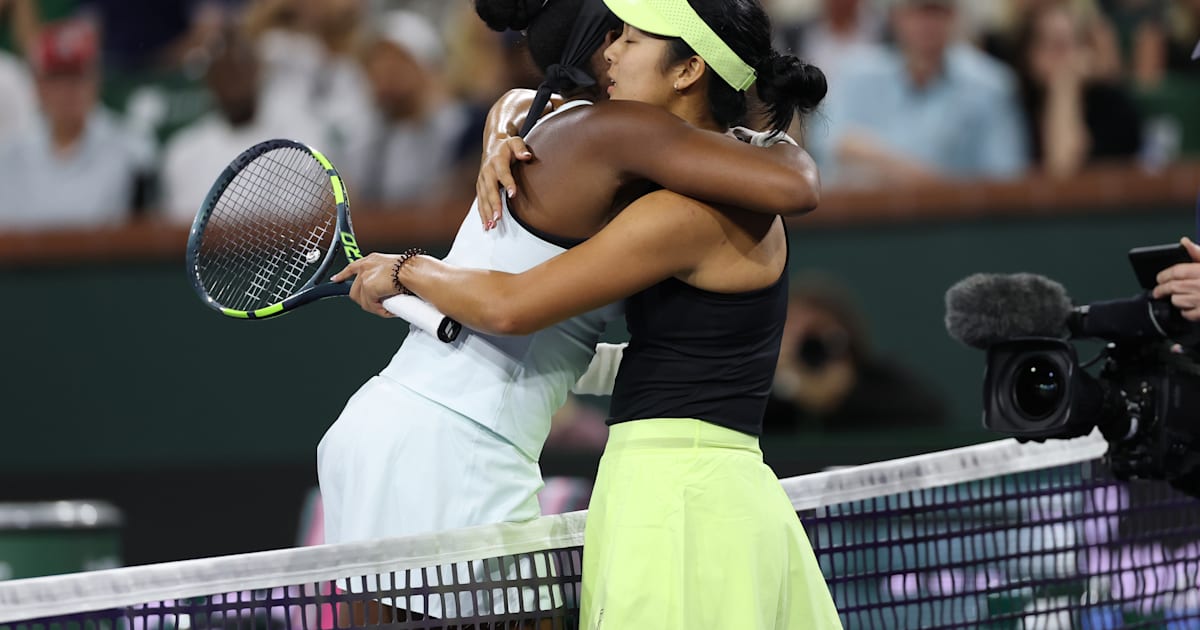
Follow The Athletic’s coverage of the BNP Paribas Open at Indian WellsAfter four days in Palm Desert, the first two rounds of the BNP Paribas Open at Indian Wells are in the books.Here are the matches and players that have stood out, some things tennis fans may have missed, and what to look out for in the third round.When is a hindrance not a hindrance?So far, 2026 is the year of the hindrance. World No. 1 Aryna Sabalenka was called on it the Australian Open, after making two noises during her usual grunt because she thought one of her shots was going out.Then Daniel Altmaier, playing at the Rio de Janeiro Open, lost a point he had won with a brilliant drop shot by crying out in anguish because he thought he had missed it.At the BNP Paribas Open Saturday, a comical interpretation of the controversial rule decided a match.Italy’s Luciano Darderi was 4-6, 6-2, 5-4, 40-15 down to Rinky Hijikata of Australia in the second round, when he hoisted a lob into the air to defend against an approach to the net by Hijikata.Before the ball could come down, Darderi pointed out in front of him and stopped play, appearing to gesture somewhere between Hijikata’s end of the court and the crowd. On the match audio, a spectator clearly and audibly says, “Oh my God.”After Darderi had pointed with first his left hand, and then his racket (in his right hand) the umpire held out a hand and stopped the point.At the other end of the court, Hijikata, who had been preparing to hit what would have been a difficult baseline smash, was perplexed. He walked toward the net, as Darderi told him that he had said, “Oh my God.”“I didn’t say anything mate,” Hijikata said in response.The chair umpire then informed Darderi that he would assess the point using video review, because players are not allowed to stop points just because someone in the crowd screams out, annoying as it is.As the review went on, Darderi’s perceived order of what had happened changed several times over, including the fleeting belief that he had not done any pointing or stopping until the umpire put out his hand.When the review was over, the chair umpire deemed that Darderi had in fact hindered Hijikata by stopping the point, and the match was over.— James HansenNo new balls, please?One of the strangest moments of the tournament so far came on Friday during the second-round match between No. 17 seed Clara Tauson and Yulia Putintseva.Tauson was about to serve, up 4-3, when play was temporarily suspended. Not because of bad weather or an issue with a spectator in the crowd, but because there weren’t any new balls for the players to play with. Rules dictate that after the warm-up and first seven games, there is a change of balls, followed by another change every nine games for the rest of the match.After about 15 minutes, play resumed with a delivery of new balls, with Tauson going on to win 7-6(9), 6-2. The ball changes were already a topic of discussion because of the tournament’s change from Penn to Dunlop, with multiple players saying that the difference between new and old is more pronounced. But this was a good old-fashioned bit of strangeness, which was a feature of the first few days, with Mirra Andreeva and Solana Sierra’s match delayed Saturday because the net on their court required replacing.And before that, here was no water for 45-year-old Venus Williams at the end of the second set against Diane Parry, played in the heat of the afternoon on Thursday. Though energy drinks were available in her cooler, Williams preferred water and requested it multiple times.“If I can’t get the waters, I’m calling the referee,” she said, before water was hurriedly brought out to her. “It is extremely unfair. No, it’s not OK.”With the wind typically strong during the match, Williams said in a news conference after losing 6-3, 6-7(4), 6-1 that: “The conditions are impossible.”Not exactly tennis paradise for her, balls or not.— Charlie EccleshareWhat is pressure in tennis?World No. 2 Iga Świątek’s opening match at the BNP Paribas Open pitted her against Kayla Day, an American qualifier. Day started the match with nothing to lose, but was unable to play with the freedom such a situation can afford. Świątek raced into a 6-0 lead, delivering one of her trademark “bagel” sets and taking her proportion of total WTA 1000 sets won by that scoreline to a staggering 11 percent.Then, Świątek said in her news conference, she “drifted off a little bit.” Her first-serve percentage dropped and some errors crept in, but Day, who already had no pressure on her, raised her level significantly higher after being bageled and therefore having even less to lose. She racked up a 5-1 lead, arcing the ball left and right and upping the intensity of her attacking play as Świątek, the overwhelming favorite with the “easy” draw reckoned with the overwhelming pressure of potentially losing a match she was supposed to win.Then, with Day a game from forcing a deciding set, she started trying to get over the line, rather than trying to crash through it. Świątek’s aggressiveness returned as Day’s faded, and the American never saw a set point despite having a 5 next to her name on the scoreboard. She played more freely again from 5-5 onward, once the opportunity to win the set had gone, but when the tiebreak arrived, it was Świątek who seized the initiative again to win 6-0, 7-6(2).These pressure dynamics are crucial to tennis matches. After a three-set win over Britain’s Jacob Fearnley, 2022 Indian Wells champion Taylor Fritz said in his news conference that “you feel the pressure the most when you’re kind of in a situation where you’re meant to win, or you’re in a position to win and you don’t want to blow the opportunity.”This dynamic happens even in contests between players at the very top of the sport, especially in matchups that are initially one-sided. The rankings gulf between Świątek and Day, at 185 places, only made it clearer.— James HansenOther notable results in the first two roundsDefending champions Jack Draper (14) and Mirra Andreeva (8) won through in very different styles, as they both look to emerge from a challenging few months. Draper, who is returning in earnest from a longterm elbow injury, defeated Roberto Bautista Agut 3-6, 6-3, 6-2 after an indifferent start. But Andreeva was literally flawless, beating Solana Sierra 6-0, 6-0.The world No. 1 and No. 2 on both tours safely navigated their opening matches. Carlos Alcaraz (1) and Aryna Sabalenka (1) beat Grigor Dimitrov (6-2, 6-3) and Himeno Sakatsume (Q) (6-4, 6-2) respectively, while Jannik Sinner (2) cruised past Dalibor Svrčina (Q) 6-1, 6-1 and Iga Świątek (2) came from 5-1 down in the second set to beat Kayla Day (Q) 6-0, 7-6(2).Wild card Donna Vekić‘s 7-6(4), 7-6(4) win over Tereza Valentová was one of the most impressive of the opening round, as was Alex Eala (31)‘s thrilling late-night win 7-5, 4-6, 7-5 over Dayana Yastremska.Coco Gauff (4) forced her way past Kamilla Rakhimova in a more complicated match for the American than a 6-3, 7-6(5) scoreline suggests, while Amanda Anisimova (6)‘s 5-7, 6-1, 6-0 win over Anna Blinkova had a a similar feel.Camila Osorio saved three match points and produced a chameleonic, more powerful performance than usual to knock out Iva Jović (18) 4-6, 7-6(4), 6-3, while Talia Gibson (Q) upset Ekaterina Alexandrova (11) 6-3, 7-5.Márton Fucsovics stunned Lorenzo Musetti (5) 7-5, 6-1 on the Italian’s return from injury, while Ben Shelton (8) came through illness to squeak past Reilly Opelka 6-7(3), 7-6(4), 6-3.Drop Shots🌴 Why the Williams sisters chose to boycott Indian Wells for over a decade — and why Serena and Venus came back.🕰️ Emma Raducanu wants to take her tennis back in time, starting in the California desert.✈️ How one tennis player, his family and his doubles partner traveled away from the missile and drone strikes on Dubai.🌪️ The wind rules over Indian Wells. This is how players cope.📱 After a tennis player shared menacing messages sent to her personal phone, the WTA Tour told players there has been no data breach.Up next: Third round🎾 Emma Raducanu (25) vs. Amanda Anisimova (6)3 p.m. ET (estimated) on Tennis ChannelAn early test of Raducanu’s convictions in being more aggressive against one of the standout players of 2025. Anisimova, like Raducanu, has had a searching start to the season, with her Qatar Open title defense hampered by illness and several matches, including wins, featuring extended periods of irritation with her tennis.🎾 Ben Shelton (8) vs. Learner Tien (25)Not before 4 p.m. ET on Tennis ChannelAn intriguing matchup — if Shelton has gotten over the physical issues and illness that made his second-round win over Opelka a grind. Tien is revelling in the home-state support in California, and embracing the change in pressure caused by going from a rising talent to a known quantity.🎾 Coco Gauff (4) vs. Alex Eala (31)Not before 9 p.m. ET on Tennis ChannelEala and Gauff met at the Dubai Tennis Championships, and a one-sided win for Gauff revealed the fundamental asymmetries in the matchup. Gauff gets to lean on her backhand against left-handers, and can loop her own forehand into theirs to get that pattern started if she needs to do so. There will also be intriguing crowd dynamics, with Gauff’s home support and Eala’s legion of fans.João Fonseca vs. Tommy Paul (23)11 p.m. ET (estimated) on Tennis ChannelFollowing Gauff and Eala on Stadium 1 is an intriguing match between Fonseca’s sledgehammer power and Paul’s skittering all-court tennis. If the American can absorb Fonseca and draw him into errors he will be the favorite, but the Brazilian is one of the people who can just hit right through the Indian Wells courts and cold nights.Tell us what you noticed in the first two rounds…



Most Popular
First One-Day International - The Stats Zone
3 hours ago