Six major concerns ahead of the 2026 World Cup: Donald Trump's travel bans, sky-high ticket prices and the war on Iran
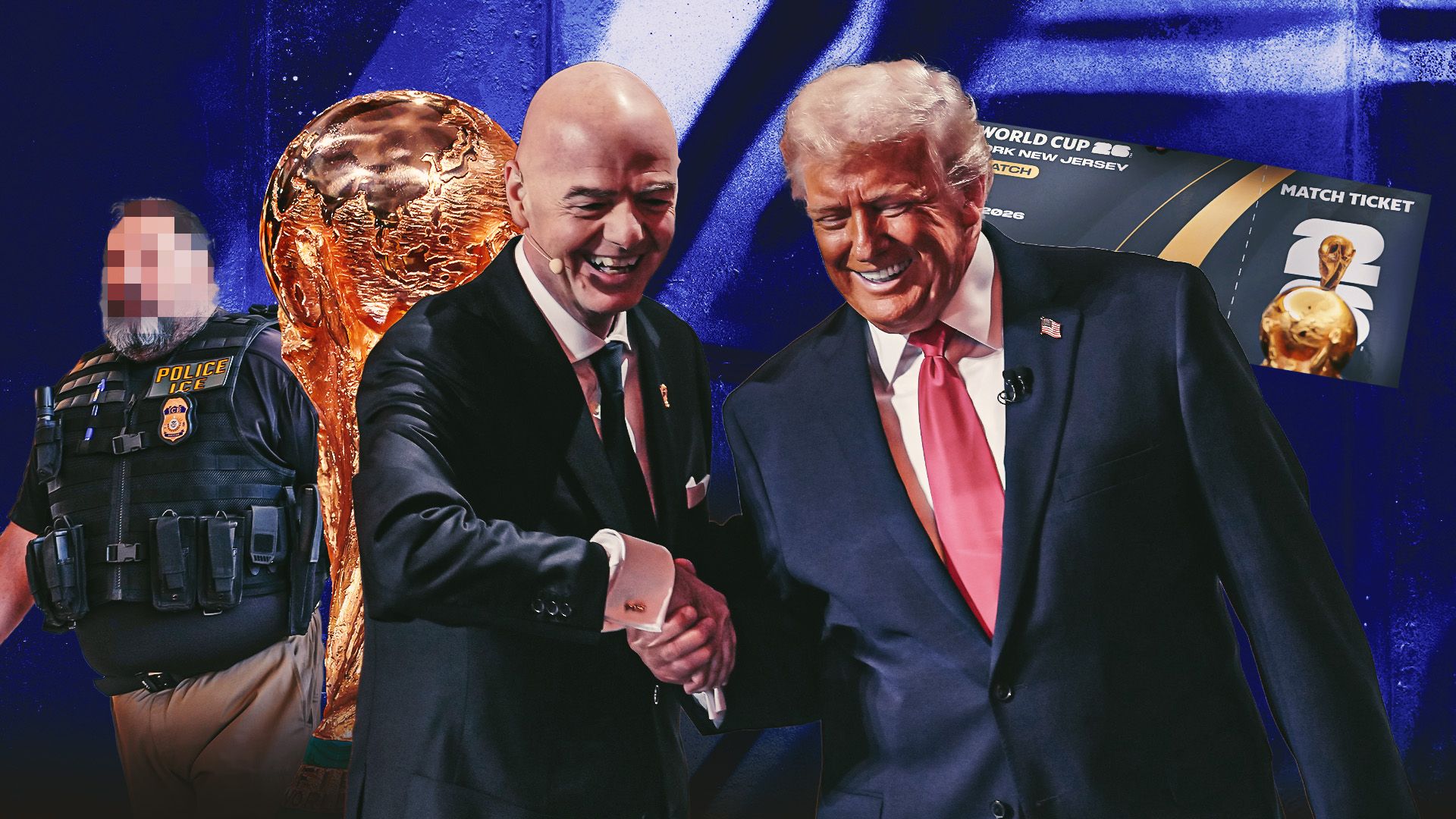
FIFA president Gianni Infantino insisted last year that "the world is welcome in America"."We will have between six and seven million tickets sold for the matches," he said. "We'll have between five and 10 million people coming from all over the world to enjoy the World Cup."Right now, though, it feels as if an awful lot of people are being excluded from what Infantino promised would be "the most inclusive World Cup ever". Indeed, just getting into the United States, which is hosting 78 of the 104 matches, is proving a struggle for several sets of supporters.The 'America First' agenda driven by current president Donald Trump has led to the implementation of travel bans for a variety of countries across the globe in an alleged bid to deter illegal immigration.Tourist visas have, thus, been made much more difficult to obtain for supporters from the likes of Senegal and Ivory Coast, while Iran and Haiti fans might not be able to enter the US at all.In addition, the 'Visa Bond Pilot Program' has only further complicated matters, as it means that citizens of not only Senegal and Ivory Coast but also Algeria, Tunisia and first-time qualifiers Cape Verde could have to pay up to $15,000 (£11,000) in deposits just to be able to travel to the States.The contentious bonds scheme has only placed further scrutiny on the cost of attending the games for the average supporter.In response to the initial backlash to the tournament's pricing structure, FIFA released a small number of "more affordable" $60 (£45) tickets for "loyal fans" of the 48 qualifiers.However, Football Supporters Europe (FSE) immediately argued that "the revisions do not go far enough" and, earlier this week, the group filed an 18-page complaint at the European Commission."For several months now, we have urged FIFA to do right by fans and reconsider its aggressive and exploitative ticketing policies," FSE executive director Ronan Evain stated."FIFA's failure to engage in meaningful consultation with stakeholders yet again has left us with no option but to join forces with Euroconsumers in filing this complaint with the European Commission."FIFA point to their unconfirmed sales figures as validation of their unfair ticket practices, while the reality is that they leave loyal fans with no other choice - pay up or lose out."The FSE identified six specific abuses, including what it called "sky-high prices", as underlined by the fact that the cheapest openly available ticket for the 2026 final is more than seven times the price of the 2022 equivalent.FIFA also stands accused of 'bait advertising' in relation to the $60 tickets, with FSE arguing that "the entire Category 4 inventory was practically sold out before general public sales opened" and that it was guilty of "advertising a price that is not genuinely available" - which is illegal under European Union law.As well as slating FIFA for the use of the hugely controversial practice of 'dynamic pricing', it was also called out for allegedly trying to control the resale market and charging both the buyer and seller a 15 percent fee, creating what the FSE called "a double win" for the tournament organisers."Fifa holds a monopoly over ticket sales for the 2026 World Cup," the FSE alleged, "and has used that power to impose conditions on fans that would never be acceptable in a competitive market."At the time of writing, FIFA's only response to the complaint, which it says it has yet to receive, is that it is "a not-for-profit organisation" and that all of the money it makes is reinvested "to fuel the growth of the game" all over the world.There's also some trepidation over what kind of sporting spectacle actually awaits fans able to afford to travel to the US and then lucky enough to make it inside US stadiums.Last year's Club World Cup was viewed as something of a low-level dry run for this summer's far grander international edition and while Infantino's pet project wasn't short on quality or upsets, the conditions caused all sorts of problems.For starters, several coaches and players were very unhappy with the state of the pitches, which Real Madrid and England midfielder Jude Bellingham said were "not great at all". Paris Saint-Germain boss Luis Enrique was particularly unimpressed with the playing surface at Seattle's Lumen Field, one of the venues for 2026."I can't imagine an NBA court being full of holes!" the Spaniard fumed after his side's 2-0 win over Seattle Sounders. "The ball bounces almost as if it were jumping around like a rabbit."Then, there was the weather. Cooling breaks were absolutely imperative due to the typically high temperatures across the U.S., while Chelsea manager Enzo Maresca said that the heat was so stifling it was "impossible" to organise normal training sessions and midfielder Enzo Fernandez admitting that he felt "dizzy" during games.FIFA's response has been to announce the inclusion of three-minute hydration breaks midway through the first and second halves of every match at this summer's World Cup - not just those affected by warm weather.This has been welcomed by some but criticised by others who view it as a cynical way of breaking the game up into American-audience friendly quarters that will afford television rights holders more lucrative advertising breaks.Unfortunately, those watching at home may be subjected to even lengthier suspensions of play, as six Club World Cup matches were delayed by thunder storms, as play is suspended in American stadiums for safety reasons when lightning is detected within a 10-mile radius."For me, it's not football," then-Chelsea coach Maresca said after the Blues' last-16 meeting with Benfica was stopped for 113 minutes. "I think it's a joke. I can understand that for security (safety) reasons you are to suspend the game. But if you suspend seven, eight games, that means it is probably not the right place to do this competition."Of far greater concern than the weather, though, is the current political climate in the United States. The Trump administration's attempts to tackle illegal immigration have caused a colossal amount of controversy all across a country composed of peoples from every possible race, colour and creed., with the conduct of the U.S. Immigration and Customs Enforcement (ICE) proving particularly divisive.In January of this year, six people died in ICE custody (Luis Gustavo Nunez Caceres, Luis Beltran Yanez Cruz, Parady La, Heber Sanchez Dominguez and Victor Manuel Diaz), while two others (Renee Nicole Good and Alex Pretti) were shot dead by ICE personnel in Minneapolis, sparking a wave of nationwide protests.Consequently, ICE interim director Todd Lyons made headlines the following month when he stated that his agency will form "a key part of the overall security apparatus for the World Cup"."We're dedicated to securing that operation and to ensuring the safety of all participants and visitors," Lyons added.By way of response, a New Jersey congresswoman introduced a 'Save the World Cup' bill aimed at preventing ICE from conducting raids within a mile of any World Cup match or fan festival."The World Cup should bring the world together and not leave families wondering if ICE agents will be waiting outside stadiums," Democrat Nellie Pou stated on Thursday, March 19 amid confusion over when security grants promised to the 11 US host cities by the Department of Homeland Security would actually be distributed."When I recently asked the head of ICE (Lyons) directly for a simple assurance that they would stay away from the games, he refused. That is unacceptable. So my legislation draws a firm line on the pitch: no ICE raids."There is no successful tournament if fans and players are looking over their shoulders. We want law enforcement to focus on strong security for the World Cup, not meeting civil immigration quotas. We should not allow fear to define this moment and ruin the games."Security also became a huge topic of debate last month, after an outbreak of deadly violence in Mexico, where members of the Jalisco New Generation (CJNG) drug cartel were involved in deadly shootouts with the country's military following the killing of its leader, Nemesio Oseguera Cervantes, during an army operation.Oseguera Cervantes, or 'El Mencho' as he was known, was the most wanted man in Mexico and at least 25 members of the National Guard were killed in the first 24 hours after his death on February 22.With Mexico scheduled to stage 13 World Cup matches, including four in Guadalajara, which is the capital city of Jalisco, the wave of violence sparked fears for fan safety at the World Cup.However, the country's president, Claudia Sheinbaum, insisted that the ongoing violence posed "no risk" to supporters and subsequently revealed plans to deploy 100,000 security personnel, including 20,000 soldiers and 55,000 police officers, as part of a massive operation to protect visiting fans.Infantino has, thus, described himself as feeling "very reassured". "Everything's good,"the FIFA chief told AFP. "It's going to be spectacular."Just last December, Infantino presented Trump with the inaugural 'FIFA Peace Prize'. However, the American president has now plunged the Middle East, and indeed the world, into political and economic chaos with a war on Iran that the US is both carrying out and coordinating with Israel - a country that several FIFA members are still calling for to be banned from international and club competition because of the ongoing genocide in Gaza and current invasion of Lebanon.From a financial and logistical perspective, the unprovoked military attacks on Iran could make it much more expensive for fans to travel to this summer's World Cup, as oil prices have sky-rocketed due to the partial closure of the Strait of Hormuz.Of much, much greater importance, though, is the shocking loss of civilian lives in Iran that prompted the country's sports and youth minister, Ahmad Donyamali, to state that it was "definitely not possible for us to take part in the World Cup".Iran is scheduled to play all three of its group games in the US and a request to have their matches to Mexico has already been rejected by FIFA, with Infantino insisting that Trump had personally assured him that the Iranians would be "welcome" to compete. Trump, though, hasn't yet deviated from his previous line that he "really doesn't care" if they do or not and even went so far as to reveal that he couldn't guarantee the safety of Team Melli.A defiant Infantino stated earlier this month, "We all need an event like the FIFA World Cup to bring people together now more than ever, and I sincerely thank the President of the United States for his support, as it shows once again that Football Unites the World."At the time of writing, though, there remains the very depressing possibility that a country that has qualified for the World Cup will not participate because it is being bombed by one of the host nations.
.jpg)
/https%3A%2F%2Fsportsmole-media-prod.s3.gra.io.cloud.ovh.net%2Fuploads%2F2026%2F03%2F1000896819-69c904a4be74e725268642.jpg)

Most Popular