Who was the first footballer to announce their international retirement?
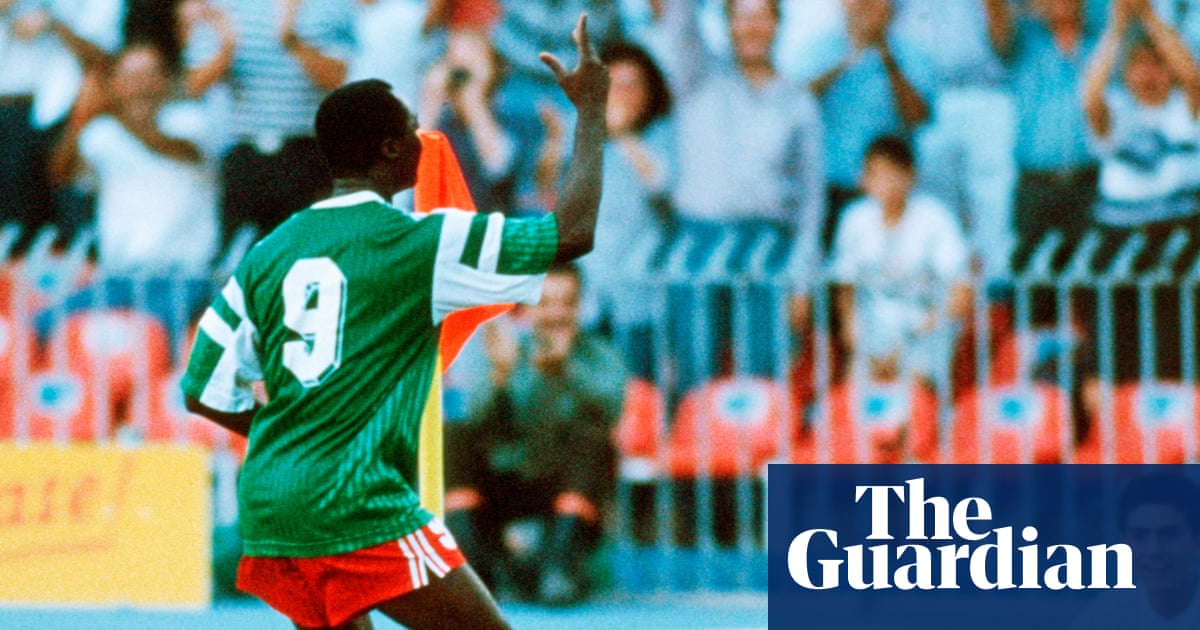
“During a rather animated discussion at the pub recently, the topic of footballers ‘retiring from international football’ came up,” says Edd Crick. “We were reminiscing about the days when footballers simply stopped being picked for international games, so who was the first to come out and declare their retirement this way?”We assumed this was a fairly modern development, but it goes back at least as far as the 1950s. Let’s look at the leading answers in reverse chronological order, starting with one of the stars of Italia 90. “Roger Milla is arguably responsible for popularising the concept of international retirement (not to mention elaborate goal celebrations) by famously unretiring at the request of the Cameroon president Paul Biya to play in the 1990 World Cup,” writes Tom Reed. “Milla had formally retired from playing for Cameroon at a jubilee event following victory in the 1988 Africa Cup of Nations.”The legendary Italy keeper Dino Zoff, who played against Milla at the 1982 World Cup, decided it was time to say goodbye in 1983 at the age of 41. Italy had just lost 1-0 to Romania, part of a desperate qualification campaign for Euro 84, with Zoff at fault for the goal. “That goal was a sort of sentence for me,” he said. “It’s by far the best to recognise the way things are going.” He played one last game, a 2-0 defeat in Sweden the following month, before bowing out with 112 caps.Next up, two of the stars of West Germany’s magnificent Ramba-Zamba team of the 1970s: Paul Breitner and Gerd Müller, who retired from international football after the 1982 and 1974 World Cups respectively.Most of you will remember Gary Lineker retiring from international football after Euro 92, but, as Tom Reed points out, he was by no means the first English player to do so. On the flight home from the 1970 World Cup, Jack and Bobby Charlton told Alf Ramsey they no longer wanted to be considered for selection. Eighteen months earlier, Liverpool’s Roger Hunt did likewise after being abused by some home fans during a draw against Romania. And after being an unused substitute at Euro 68, when Hunt and Geoff Hurst were preferred up front, Jimmy Greaves, still only 28, told Ramsey he was done. These sound like private conversations rather than public announcements, but they are well worth mentioning.A search of the newspaper archive brought up an even earlier retirement. In September 1954, two months after captaining West Germany to a stunning World Cup victory, the 34-year-old Fritz Walter called time on his international career. “I want to go out,” he said, “while I am at the top.”He didn’t quite manage it. Two months later Walter got the itch and returned to the national side. He played for another four years and saw West Germany’s World Cup defence through to the bitter end: his last cap was a 3-1 defeat by the hosts, Sweden, in the 1958 semi-final.Swift ascents up the pyramid“If Wrexham get promoted from the Championship this season that will make four consecutive promotions,” writes Ant Gee. “Has any other team achieved that or more?”With seven games remaining, Wrexham are seventh in the Championship and outside the playoff places on goal difference, so another promotion is not beyond the realms. Not bad for a team who started the 2022-23 season by coming from behind to beat Eastleigh 2-1 in the National League.No side has ever reached the English top flight after three promotions in a row, never mind four, though Swansea (1977-81) and Wimbledon (1982-86) managed three in four years.A couple of English teams have managed four promotions in a row further down the pyramid. Shaw Lane jumped from 12th tier to the eighth between 2011 and 2015, as did Truro City from the 11th to the seventh between 2005 and 2009.“The newly formed Chester FC jumped four divisions in three seasons from 2010-11 to 2012-13,” adds Tom Reed. “Initially placed in the ninth tier for their inaugural season, the FA then bumped them up to the eighth tier before a ball was kicked in 2010-11. They were then promoted as champions in each of the next three seasons to reach the fifth tier.”Teams who tumble down the pyramid for financial reasons are usually good candidates for multiple promotions. Parma were relegated from Serie A to Serie D in 2015 after being declared bankrupt; three seasons and three promotions later, they were back among the elite. Frank Van den Heuvel also mentions Beerschot KAV: after tumbling down the Belgian pyramid due to financial issues, they jumped from the First Provincial League (tier six) to First Division B (tier two, now the Challenge Pro League) from 2013-17.Olympique Akbou reached the top flight in Algeria after five consecutive promotions between 2018 and 2024 (the Ligue Régional I was not held in 2020-21 due to Covid). That was the most we could find for a team ultimately reaching the top flight. The highest overall was in the Czech Republic between 1999-2000 and 2005-06. Not only were Tatran Jakubcovice promoted seven times in a row; they were champions each time. Their bid for world domination stalled when they finished 11th in the second tier (2. česká fotbalová liga) in 2006-07.The Hornets’ nestIn last week’s Knowledge we looked at uninjured goalkeepers who were substituted in the first half. Andy Myall, Richard Scrimshaw and Peter Skilton all wrote in with a tangential tale from Watford that is well worth telling.“Steve Palmer was the ultimate utility man,” recalls Peter. “In 1997-98, the last season before squad numbers were introduced in the Football League, he was on course to wear all 14 numbers (just three subs in those days).”The Watford manager, Graham Taylor, decided to help Palmer out. “He started in goal in the last home game of the season, against Bournemouth,” continues Peter. “After the ball was put out of play straight from the kick-off, Palmer swapped shirts and positions with the regular keeper, Alec Chamberlain, who had started outfield. Oddly, it wasn’t the last squad number Palmer needed for the full set – he went on to wear No 9 a few days later.”You can read more about Palmer’s numerical journey here.Knowledge archive“As a child I watched Serbia & Montenegro v Tunisia at the 2004 Olympic football tournament, when a penalty for Tunisia was repeated by the referee seven or eight times,” tweeted grbomadjija in 2014. “Unfortunately I can’t find video but I remember we lost 3-2. Is it the record for repeating one penalty?”“The penalty was only taken six times,” recalled Alun Thomas, sending this video link. Watching the players outside of the penalty area is fun: the first couple of times, they race into the box; then, they start attempting to mimic the pace and length of the taker’s run-up, to avoid getting in to trouble. In the end, they’re stood with their hands on their knees, just watching. “The referee was Charles Ariiotima from Tahiti,” Alun added. Ariiotima became the director of the Tahitian FA. “He is also notable for changing the league points system on the island to award one point for a loss, saying: ‘We just don’t want anyone to be sad. With this system, even if a team loses every game they won’t be on zero points at the end of the season. Football, first of all, is joy.’”Here’s the AFP report from the game:double quotation markWith the Group C match level at 1-1 and in the dying stages, Tunisia were awarded the spot-kick for a foul in the box. Up strode experienced striker Mohamed Jedidi to take the kick and he scored confidently in the corner. At least, he thought so. Referee Charles Ariiotima from Tahiti ordered the penalty to be taken again and again after Tunisian players were accused of encroachment as Jedidi twice more found the net successfully. Jedidi then had the fourth kick saved by Nikola Milojevic. Again Ariiotima was unhappy claiming that it was the Serbian players who had drifted into the 18-yard area and the Europeans were accused of the same offence on the fifth kick which again was stopped by Milojevic. Incredibly, the 25-year-old Jedidi kept his nerve to legally convert the sixth kick.”While it was sixth time lucky for Jedidi in a 3-2 win for Tunisia, neither team advanced to the quarter-finals.Can you help?“The Bundesliga table shows Bayern Munich on 70 points with an eye-popping goal difference of +72,” pops Chris Fryer. “Has any club won the league with a greater goal difference than points tally?”“Endrick has scored on his debut in the Champions League, Europa League, La Liga, Coupe de France and also in his first game for Brazil,” writes Jonathan Braga. “Has anybody scored as many debut goals at the highest level?”“Midtjylland lost their penalty shootout against Nottingham Forest with zero shots on target – two hitting the post and one over the bar. Is this a first for a competitive fixture at this or indeed any level?” asks Paul Reeve.“All of the Champions League last-16 ties were won on aggregate by at least two clear goals,” notes Dave Parsons. “Has this ever happened before?”“Chris Pike, Gareth Bale’s uncle, scored a hat-trick against three different goalkeepers – John Keeley, Roy McDonough, and Nathan Munson – in a match for Hereford against Colchester United on 16 October 1993. Anyone for any more?” asks Alvin Martin Rob Davies.




Most Popular